Simply Resourceful

Simple ways to be more conscious about how we use our resources.

Showing posts with label Bees. Show all posts

How to Make a Cutting Board

Friends of ours recently announced they got married.  For a wedding gift we made them a cutting board using walnut and hickory wood.  The walnut was milled right here on our property.

The cutting boards were made from scrap pieces so the strips of wood are different widths.  And really, does it matter?  In the picture above, Jon is gluing the wood strips together. 

After clamping each cutting board overnight, the edges were squared off using the bandsaw.

To get a smooth, even surface, the cutting boards were put through the planer a few times. 

For a rounded edge, Jon used a router on all sides, top and bottom.

We used a scroll saw to remove the sharp corners and give them a rounded look. 

The bench sander allowed for easier sanding on the edges to get rid of irregularities from the router and scroll saw.

To seal the wood, I used spoon oil.  Spoon oil is made with beeswax and a neutral oil such as sunflower, safflower, soybean, flax, or canola.  Mineral oil is commonly used but it is a petroleum product.  I used safflower oil because it was in my cupboard.  I made a small batch of spoon oil with 2 ounces beeswax and 4 ounces safflower oil.  Each cutting board only needs about 2 teaspoons of the oil so the excess will be used on more cutting boards and wooden spoons.  This website gives step-by-step details for making spoon oil.

A little dab of spoon oil goes a long way.  I used a cotton cloth to massage it into the wood.

The above picture shows the difference before and after the spoon oil was applied.  The grain of the wood literally pops out at you!

The finished product!  Total time for this project took maybe 1.5 hours.  Cutting boards use up scraps and make excellent presents.  


Growing Buckwheat for Honeybees

During a visit to Portland, Oregon early this summer, I stopped at Ruhl's Bee Supply. This was my beekeeping supply store when I lived in Portland and I couldn't resist stopping by to look around, taste some honey, and take deep breaths of the beeswax smell!  Before leaving, I purchased a Swienty Feeder for use inside my vivaldi board and one pound of buckwheat seeds.  The seeds were planted in mid-July and flowered in late August. Buckwheat was sown after the carrots were pulled.  Buckwheat is a great green manure/cover crop, weed suppressor, and an excellent nectar source for honeybees producing a very dark and rich honey.  This very low maintenance crop will be grown again!


Hot Summer Days

There are only a few hot and humid days left this year.   I am enjoying the final ones reading a good book and drinking homemade ginger ale on the porch.  

During the really hot days, the chickens keep to the shade of the woods and only wander in the yard occasionally with their wings slightly flared to catch a breeze.  We think they look pretty funny with their wings out like this! 

The honeybees form beards outside their hives at night to bring in the cool air. 

And Jon and Paul make homemade ice cream.  Just when we are about to complain about the humidity, we remember the frigid January days when the pipes froze last year and we were huddled under blankets.  We are grateful for all of the time outside and soak up the heat when we have it!


Snapshots of a Summer Day

It's been awhile since I wrote a post about a typical day here at the Wolfe house.  Our day begins with opening the chicken coop and closely watching the hens scatter into the weeds to lay their eggs.  With the snake coming and going from the coop, only two hens lay eggs in the coop.  Finding the nests in the weeds have been a challenge because the hens only lay in the same spot for a few days before they make a new nest.  The nest in the picture was located next to the creek where a very large snapping turtle lives so I promptly moved the eggs.  We would love to have baby chicks (in case they get broody), but the snapping turtle is a bit of a threat.

The snake left for about a week but promptly returned to devour two eggs before I gathered them.

Most days we throw something outside the garden fence or patio door for the chickens to eat.  In the picture above they are devouring a squash that was half rotten.  We did cull one of the barred rocks a few weeks ago.  She was the runt of the litter who was bullied by the other hens and she even started pulling out her own feathers.  When she stayed in the coop all day and lost a lot of weight, I decided it was time to cull her.  For weeks there were eggs in the nest box without shells and ones that easily broke when touched.  It was no surprise that when she was culled, she was egg bound.  Her grooming habits had lessened and she also had a terrible case of lice.  I promptly treated the flock with Poultry Protector even though they all looked really good thanks to daily dust baths.  


Fresh produce decorate the kitchen counters all summer long.  This year we have a beautiful assortment of tomatoes.  The yellow ones are Wapsipinicon peach.  With the temperatures being somewhat cool this summer, we have been enjoying fresh bread as well!  Using the oven and keeping windows open all day long is a treat!

The garden is a jungle right now with so many weeds, sprawling tomatilloes, and never-ending squash vines.  I'm not sure how or when this happened, but the tomatoes took over!  In the picture above there is no room to walk and you can barely see two distinct rows.  This crowding is a bit of a concern for spreading of disease and picking the tomatoes without damaging the plants.

Many of the tomato plants have some blight but these black tomatoes are looking terrific!  The stalks and leaves are healthy and the tomatoes don't show signs of rot.  We aren't sure what the actual name of these tomatoes are because we saved the seeds from a tomato our friend Anna, so we affectionately call them "Anna's Black" tomatoes.

And of course, it's not summer in our home without the small room next to the kitchen cluttered with preserving supplies...canning jars, food dehydrator, canning pot, cider press, etc.  It is nice having this extra space so I don't have to put things away after each use.

This summer the honeybees have been left alone to do their own thing.  Each hive started with not even 10 frames of partial comb so harvesting honey was wishful thinking.  During our recent inspection, one hive was very prolific with four frames of solid capped honey whereas the other had not a single frame of solid honey.  Both hives look healthy with a good population and laying queen.  Entrance reducers were put on both hives because last August, the hives were robbed by the yellow jackets and wax moths.  The entrance reducers should help the colonies defend their home and reduce any robbing that may occur between the two hives.  In the picture above you can see Paul wearing very little while my friend and I are performing an inspection.  He is not afraid of the bees and is always present during inspections.  The last incident of a honeybee sting happened when he was 2.5 years old in a small pool.  Three years later he is still running around barefoot through clover wearing only a pair of underwear all summer long.  Paul is a pretty care-free child who runs across gravel barefoot and rolls in the weeds filled with chiggers.  

Every year we use a different trellis for beans but we are never satisfied with the results.  The beans always seem to run out of room, trellises fall over, or the beans are too crowded.  This year Jon came up with a brilliant idea to use the greenhouse as a bean trellis!  There isn't much use for the greenhouse during the summer because of our hot and humid temperatures so we removed the plastic covering and planted things in and around the greenhouse frame.  I will be blogging about the bean trellis soon but everyday we stop by to marvel at the number of hanging beans and to observe the pollinators on the sunflowers.

And after a day of hunting for eggs, preserving produce, pulling weeds, and making plans for the next day, we take some time to walk around the garden and mini orchard to enjoy the fruits of our labor.  It is so easy to get caught up with all the work that needs to be done, but we stop and do what we call a "walk around."  This is a time for meandering around to observe everything and pat ourselves on the back.  While Paul runs ahead of us to marvel at how much his asian pear tree has grown; Jon is squeezing a peach to check for ripeness; and I watch honeybees make their final trip home for the day covered in bright orange pollen.  


My First Bee Tree!


It's always hard to get away from the homestead, but we think it's important to take time away from all the chores and enjoy other family activities that we don't make enough time for.  This weekend we decided to go camping in Ohio.  During one of our walks around the lake, Jon pointed out a large sassafras tree.  While looking at the gaping holes on the trunk, I spied some movement.  I immediately stopped walking, pointed to a hole, and exclaimed, "Jon!  A bee tree!"  I have been waiting for years to come across a bee tree in the woods.  Every time I see knot holes in a tree, I am looking for flying movement.  Jon and I stood a long time quietly observing the hive, listening to their subtle hum, and watching them come and go from the entrance. What an exciting experience for all of us!  And later on during the hike, we found a large paw paw patch!


Flowers for the Honeybees and Other Beneficials


When we first started gardening, the focus was strictly on growing food.  At the time, I wanted to minimize the weeding and thought flowers took up too much of our time.  After having honeybees for 5 years and gardening organically, I have learned that flowers in the garden play a larger role than just beauty.  Flowers attract the beneficial insects to our garden that keep the harmful pests to a minimal level.  Each year we plant more flowers in the garden and around the property.  In the garden between the asparagus and strawberries, we have a herb and flower section.  Listed below are some of the flowering plants we grow on the property:


Basil flowering in the fall.
  • Chamomile
  • Pincushion
  • Marigolds
  • Amaranth
  • Borage
  • Nasturtium
  • Bee's Friend
  • Cupplant
  • Wildflower Mix
  • Thyme
  • Lavender
  • Sage
  • Rosemary
  • Purple Coneflower
  • Foxglove
  • Leeks
  • Firesticks
  • Sorghum
Firesticks

To remember where the seeds are planted, we use small sections of PVC pipe that we found under the porch left behind from the previous homeowners.

Leeks produce beautiful globes that attract a lot of beneficial insects!

Attracting parasitic wasps in the garden is really important when fighting the tomato hornworm.


A Spring Freeze and Our New Honeybees Leave

Last week my blog post was celebrating the arrival of spring and wishes for a good summer harvest.  Well, it seems my excitement was a bit premature after we had a hard freeze (low temperature reached 22 °F) on April 15th. In the last week, one of the package bees left the hive without warning, almost all of the tomatoes and peppers in the greenhouse were killed by the hard freeze, and two fruit trees aren't showing any life at all.  It was a rough winter and the start of spring isn't looking any easier.  This is the reality of things here which reminds me how frustrating homesteading can be.  For us, these few inconveniences set us back only a little bit of money and a few weeks of extra growing, but for those who make their livelihood selling produce, this is a travesty.  Growing food completely reliant on the weather patterns without the modern technologies of hydroponic growing, temperature-controlled greenhouses, and irrigation sensors, is a challenge.  When I hear shoppers complain about the price of food and how cheap food used to be "back in the day," I am reminded how much time and energy it takes to germinate peppers and tomatoes and how one hard freeze can wipe them out.  But onward we persist with growing our own food, starting with replanting all of those containers in the greenhouse.  The peppers and tomatoes will eventually get planted in the garden and we still have many living fruit trees, and two honeybee hives.  Homesteading isn't always rainbows and butterflies, but we still have many things to be thankful for and lessons to learn---starting with taking plants inside no matter how much of an "inconvenience" it seems at the time!

Many strawberry blossoms were effected by the frost.  The blossom on the left can yield fruit, but the one on the right is dead.

A picture of what a hard freeze does to rhubarb.  


Life After a Long Winter

This blog has a lot of how-to and informative posts, but sometimes I need to step back from routine and highlight all of the great things that are going on at the homestead.  Sometimes I can get discouraged when following other blogs and seeing all the pristine photos with weedless gardens and blemish-free produce, but I remind myself that we keep things real here at the Wolfe house.  This is the beginning of our 3rd year at this house and we are excited to see many of our efforts spring to life with the warm weather slowly creeping in. I think many of us can agree that spring was slow to arrive, but each day this week I am thrilled to see bits and pieces of the property wake up to warm weather.  I look at the soil and see so much potential with the green manure putting nutrients back into the soil and flower buds swelling on the fruit trees!  So here's a virtual toast to a bountiful harvest this summer!

This week, 3 colonies of Italian honeybees arrived from Kelley Bees.  This season I am taking on an apprentice beekeeper who paid for one colony of bees in exchange for hands-on education and a share of the honey crop.  Having an apprentice will keep my mind sharp on the inner-workings of the hive and give me reason to go into the hives more often.

Our girls are tuckered out with all the scratching!  After months of cold weather, they are eager to get out of their coops every morning and scratch under the leaves for all those tasty grubs coming up to the surface.  After a few hours, 2 of the chickens decided to take a sun bath on the front steps to give their legs a rest.     

This picture was taken a month ago.  Many of the seedlings are already transplanted in the garden.  Some days the greenhouse gets so hot (110 degrees) we have to prop the door open. 

At the end of February I started sprouting potatoes but the weather was really wet and cold the week we wanted to plant them.  The potatoes were quickly starting to shrivel up so Jon put them in the rain barrel planter on the porch under a layer of moist dirt and composted chicken manure.   

After 2 weeks, the potatoes were hydrated and growing roots so they were transplanted into the garden. 

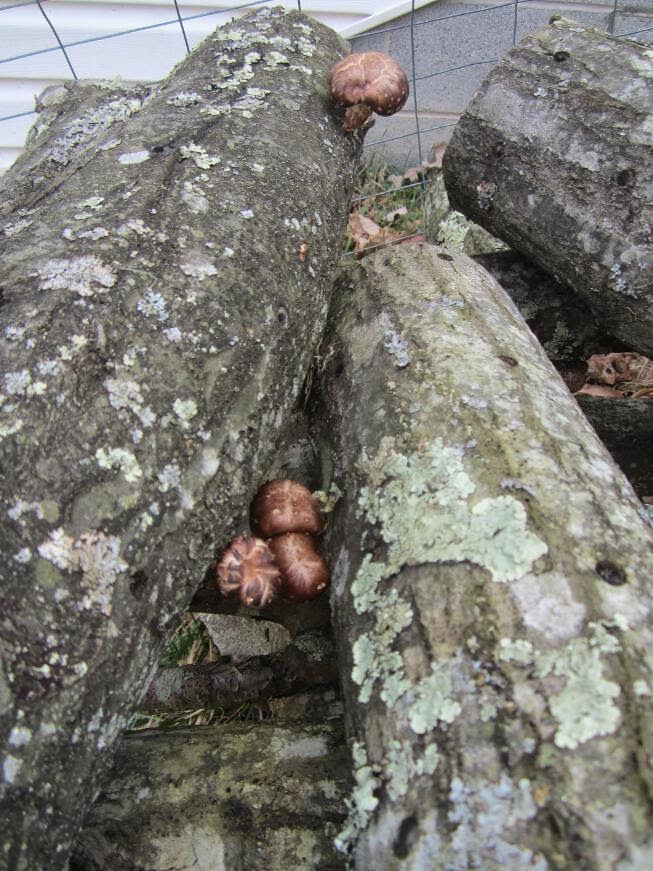
The mushroom logs started sprouting this week!

All of the fruit trees have blossoms and many have already opened.  We hope no more frosts!

A snapshot showing half of the garden.  The green strips show the green manure growing back after dying in the winter. 

Here's the other half of the garden with the green manure tilled under and ready for planting. 

The cold frame was a success this spring... lettuce and spinach coming up! Varieties: hotshot mustard mix, arugula, gulley's favorite, lettuce mixture, and giant winter spinach

The brassica plants (cabbage, cauliflower, and broccoli) have been transplanted.  This year we plan to use remay to keep the cabbage moths away.  We'll be posting about that sometime in the near future.  Cabbage is shown in the above picture. 

In the fall Jon planted music and great northern white garlic at the end of each row.  We keep reading how garlic keeps the "bad" bugs away so instead of planting a patch of garlic, we are growing 2 bulbs at the end of each row to hopefully maximize the benefits of garlic since our garden is so large.  It's hard to see the garlic in the picture above since the green manure is growing in areas but they are on the far left side. 

The asparagus are poking their heads through the soil.  This year we can finally harvest the spears!


About this blog

A weekly update on our adventures of trying to be more self-sufficient by using resources wisely. We explore a variety of topics that most broadly fit in the "Homesteading" category, i.e. beekeeping, organic gardening, edible landscaping/fruit forest, food preservation/canning, woodworking, soap-making, and environmental stewardship.

Search My Blog

I've been featured on:


Followers

Facebook

Contact Form

Name

Email *

Message *

Powered by Blogger.