Simply Resourceful

Simple ways to be more conscious about how we use our resources.

Showing posts with label Pests. Show all posts

Deer Girdled Our Fruit Trees!

After four years of care, our fruit trees finally reached a height where deer damage isn't a concern.  The deer will prune the lower branches for us, but the trees are tall enough to survive.  This fall Jon decided to remove the cages from around the trees because mowing grass around the cages are a hassle, weed-whacking inside the cages several times each summer is a hassle, and all that fencing is an eye-sore.  The trees looked absolutely beautiful standing proud in our field; until one night, deer decided to rub their antlers on their trunks and rip their bark off!   It only took one night of exposure for twelve out of the thirty-one un-caged trees to be girdled.  This was certainly a devastating blow after four years of care.  Some of the trees are even loose in the ground from the force the deer exerted on their trunks. 

A week after this happened, we ran into a retired DNR Forester who has had great success with hanging an empty pop can from a rope from a low branch to keep deer from rubbing.  If only we knew this before the trees were girdled!  

What can we do to help the trees that have already been girdled?  Some say the trees will either live or die no matter what an orchardist does to help the situation. One common treatment is covering the wound with latex paint to protect the inner cambium layer and seal off the potential for disease. 

If there is a strip of bark 1/4-1/2 inch thick still in-tact the full length of the trunk, the chances of survival are even higher. 

This is one hard lesson learned, that's for sure!


Fall Gardening

Autumn is here and our garden is still producing for us.  In the past, we either didn't get the fall crops started at the right time or we didn't have the ambition and energy to tackle a fall garden.  This year however, the stars must have aligned because fall gardening is in full force!  

Using row covers is definitely the way to go with pest control and keeping jack frost from nipping the plants.  The pea pods in the back of the picture are exposed to the elements because they don't have pest problems and can tolerate the frosts. 

The Oregon Sugar Pods were planted the second week of August and have produced several bowls of delicious pods for three weeks. 

Arugula is thriving but the lettuce has been slow. 


The beets were planted at the same time as the pea pods and the kale were transplanted the first week of September.
The brassicas (cabbage, broccoli, and brussel sprouts) were transplanted the second week of August.

The celery was planted in the spring and limped along all summer with frequent watering.  Now that fall has arrived, the plants are thriving with crisp stalks that are excellent in soups!

Paul spotted a large preying mantis on top of the row cover a few weeks ago.

A giant hornworm was found on a ground cherry plant last week.  These suckers are huge and stripped the plant of all its leaves!


Fighting Flea Beetles With Basil Flowers

A few weeks ago I blogged about fighting flea beetles with used coffee grounds and wormwood.  We have had good success with this method even with the rain diluting the strength of the coffee.  This week we found another quick way to keep flea beetles away: basil flowers!  We have 10 basil plants that keep trying to go to seed and we have found that placing the basil flowering heads on the eggplant leaves keep the flea beetles away.  We have never seen this mentioned as a flea beetle deterrent so we could just be lucky or there may be something to this strategy.  We won't think too hard about it though, we are just thrilled that it is working!

Picture above shows basil flower resting on the eggplant leaf.

Isn't this Listada De Gandia Eggplant so cute?! 

Casper Eggplant

Unknown eggplant variety given to us from a friend.


Fighting Flea Beetles With Coffee Grounds

If you grow organically, flea beetles are probably one of the top five most peskiest bugs in your garden.  They are small black bugs about the size of a poppy seed.  They feed on the leaves of plants and jump when disturbed.  For young plants, it can kill them overnight.  In our garden, the flea beetles pose the biggest threat to eggplants, tomatillos, potatoes, and arugula.  We have found three ways to keep these pesky critters at bay: row covers, hot pepper spray, and used coffee grounds.  Jon collects coffee grounds at work so we have an abundance of them to use in the garden.  Simply spread the coffee grounds under the plant and reapply after it rains.  In the above picture, fresh coffee grounds were sprinkled underneath a young tomatillo plant.


The challenge with only using row covers is that flea beetles hatch from the soil each year so your plants can get infested with the beetles even though they are in an isolated bubble.  Row covers are the easiest form of pest control to use though  because you don't have to worry about rain washing the hot pepper spray off the leaves and dissolving the coffee grounds into the soil.  To give the fragile eggplants a head start we use both the row covers and coffee grounds.  This year we did plant wormwood with the eggplants because we learned that they are a great companion plant.  The problem with wormwood is that it emits a chemical that stunts plant growth, so we are not so sure how beneficial it is.  Perhaps growing the wormwood in containers and setting them within the eggplant patch would be the better option.

Go here for another post about flea beetle control!


Using Cattle Panels As a Tomato Trellis

Cattle panels seem to be a versatile item around the homestead.  Last year we used them for the greenhouse project and bean trellis.  This year we are using them as a tomato trellis.  I have seen gardeners cut the cattle panels into boxes or lay them parallel to the ground for supporting their tomatoes.  We decided to try a simpler approach of not cutting the panels and just staking them perpendicular to the ground.  The advantage to this approach is easy access to the weeds.  We will see how this method works and give an update later in the summer.

In between the tomatoes we alternated basil and borage.  Basil enhances the tomato flavors while tomatoes enhance basil flavors.  In the picture above you can see a small borage plant to the left of the tomato.  Borage is a companion plant that helps combat the tomato hornworms by attracting the parasitic wasp that lays its eggs on the hornworm.  The wasp larvae kill the worm by eating it.

Look closely...there is a large hornworm on the tomato stem.  If left alone, the hornworm will strip the entire plant of its leaves. 

Here is a dead hornworm after the wasp larvae killed it.


How to Prevent Peach Borers


On a warm January day, Jon, Paul, and I took a walk around the property and discovered a pool of  jelly-like substance around the base of the peach trees.  I did a bit of research and there seems to be a lot of reasons for the sap leakage.  Some say borers are the main culprit whereas others suggest a bacterial or fungal infection.  One peach grower on a forum says this can happen to young trees when sap pressures are high in early spring and there is a weak graft that has not closed completely,  
After clearing away the sap and a little investigating, we did see holes that would indicate borers. These borers feed on the cambium layer of the tree between the bark and sapwood.  They typically attack the tree between 3 inches below ground to 10 inches above ground. 

This is our first time raising peach trees and we garden using only organic methods.  Besides sticking the end of a paperclip into the borer hole to kill the feeding larvae, organic growers suggest using Tanglefoot, a sticky paste made from natural gum resins, vegetable oil, and wax.  You first wrap the first 12 inches of the tree trunk and a few inches below the soil with strips of stretchy material (e.g. t-shirt) and then apply Tanglefoot directly to the t-shirt.  Tanglefoot traps insects because it is so sticky, thereby preventing the moths from laying eggs on the trunks of the tree.  This is more of a preventative approach and a fine example of why you need to do your research and be proactive rather than reactive.  After three years of watering, weeding, and pruning, the trees may be too weak to survive.  Now that the borers have established themselves, it will be nearly impossible to keep them under control because the borers laid their eggs under the bark last summer/fall.


How to Kill Yellow Jackets Without Chemicals

This month Jon came across a yellow jacket nest while mowing the lawn.  The nest is located about 3 feet from an apple tree so using chemicals or gasoline like many suggest, just wasn't an option.  Doing a quick Google search, we came across this idea: put a glass bowl over the hole so the yellow jackets can't escape.  The bowl lets light into the nest so they fight like mad to get out and tire themselves out without any access to food and water.  

We used two bowls to ensure that any yellow jackets that managed to sneak under the first bowl were caught in a second trap.  After four days we checked to see if there was activity and discovered the bowls off the hole and the nest dug out of the ground.  We're thinking a skunk found the nest and raided it since the yellow jackets were probably pretty weak at this point.  Problem is now solved! 


Some Chickens Love Japanese Beetles

You know the phrase, "One person's trash is another's treasure?"  Well, the same thing can be true for bugs.  Some garden pests such as Japanese Beetles are a huge problem in our garden, in particular when it comes to grapes, berry plants, and edamame. These beetles have a hard exoskeleton and are not easy to squeeze between the fingers so we knock them into a bucket with a little water in it.  (The water keeps the beetles from flying out easily.)  One of our chickens, who we affectionately call "Turkey", absolutely LOVES the Japanese Beetles (and their grubs in spring) and she comes running to us from across the yard whenever she sees us carrying a bucket---talk about a good example of classical conditioning (remember Pavlov and the salivating dog from Psychology class?).  Turkey is so eager to eat the beetles that she literally climbs into the bucket to get them!  Turkey has made it very clear to the rest of the flock that only SHE can have the beetles; we don't mind - she literally eats hundreds of them at one sitting.


Damage to the edamame (soybean) plants from the Japanese Beetles.  They are most prevalent in the early morning and evening hours.

A Happy Turkey after a Japanese Beetle snack. 


Using Row Covers for Pest Control


Every year we try something new in the garden.  This year we are using row covers for the plants that receive the most pest damage.  This list includes: members of the brassica family (e.g. broccoli and cabbage), eggplant, squash (e.g. Turk's Turban and Hubbard), and bush beans.  These plants seem to attract pests that do heavy damage to the crops.  By using row covers, we are essentially keeping the moths and other pests out which will save a considerable amount of our time.  The pests include: cabbage worms, flea beetles, squash vine borers, and mexican bean beetles.   

The row covers (Agribon 19 83'' x 50') were purchased from Peaceful Valley Farm & Garden Supply.  We used #9 wire that was purchased through Grower's Solution on eBay. 

Each wire was cut about 6.5 feet long.  


Plants were put under the row cover on May 4th. 

The above picture was taken on May 17th.  This spring has been abnormally dry which makes watering under the row cover a challenge.  A drip line would be great for this.  We have noticed that the plants under the row cover have required less watering than the plants exposed to the direct sun all day long. 


The above picture was taken on May 30th.  No cabbage worms so far!

The row cover was removed about 2 weeks before our first broccoli harvest because the plants were pushed up against the row covers and the fabric couldn't raise any higher.


The squash looks beautiful this year because squash vine borers haven't gotten to them yet.  They are too big for the row cover so they are out in the open.  The squash are putting down roots along the vines so we have been covering sections of the vines with dirt.  We were told if the plant is rooted in several places, it has a better chance of surviving the squash vine borer because even if the main stem is injured, the remaining vines should be okay.  We'll see if this "trick" works!


Flowers for the Honeybees and Other Beneficials


When we first started gardening, the focus was strictly on growing food.  At the time, I wanted to minimize the weeding and thought flowers took up too much of our time.  After having honeybees for 5 years and gardening organically, I have learned that flowers in the garden play a larger role than just beauty.  Flowers attract the beneficial insects to our garden that keep the harmful pests to a minimal level.  Each year we plant more flowers in the garden and around the property.  In the garden between the asparagus and strawberries, we have a herb and flower section.  Listed below are some of the flowering plants we grow on the property:


Basil flowering in the fall.
  • Chamomile
  • Pincushion
  • Marigolds
  • Amaranth
  • Borage
  • Nasturtium
  • Bee's Friend
  • Cupplant
  • Wildflower Mix
  • Thyme
  • Lavender
  • Sage
  • Rosemary
  • Purple Coneflower
  • Foxglove
  • Leeks
  • Firesticks
  • Sorghum
Firesticks

To remember where the seeds are planted, we use small sections of PVC pipe that we found under the porch left behind from the previous homeowners.

Leeks produce beautiful globes that attract a lot of beneficial insects!

Attracting parasitic wasps in the garden is really important when fighting the tomato hornworm.


Dealing with Termites

Less than a year after purchasing our home we found a spot in the floor of the breakfast room that heaved a bit.  We figured it was from moisture and the fact that the installer nailed this "floating floor" around the edges which created the bulge.  Well, Jon decided to replace the 3 boards that were ruined (thank you previous owners for leaving extra flooring!) and when he opened the floor, this is what he found...

Lovely...and there were termites crawling around.  Apparently they eat sub-flooring because you can see it crumbled to pieces. This small 8x10 room has a crawlspace (the only part of the home with a crawlspace) and it is very damp under there because there isn't cross ventilation and the previous owner didn't cover the entire space with plastic.

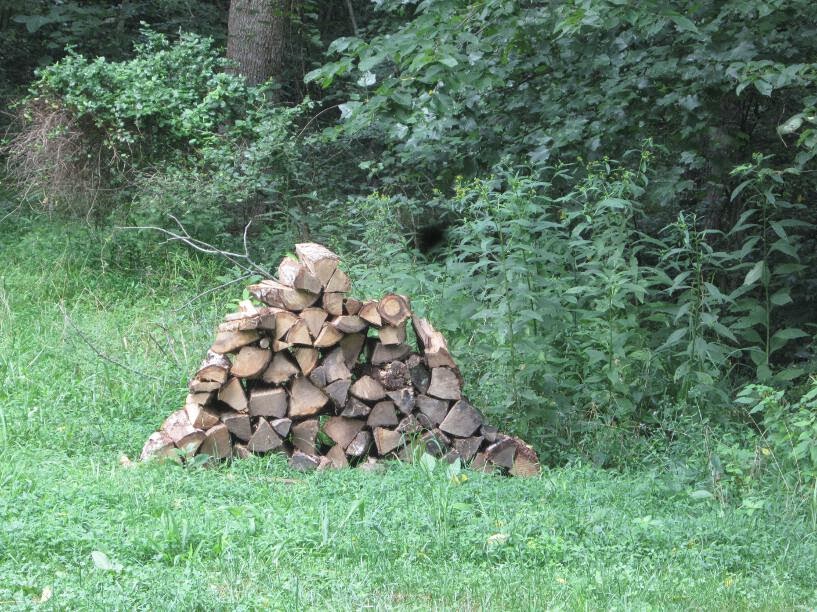
We decided to remove ALL fiber material (e.g. cardboard) and wood from under the porch including the woodpile left by the previous owners.  We stacked it far from the house and sure enough those logs were light as feathers and infested with termites.  We call this our $1,000 wood pile.  The wood will be used this winter for maple syrup boiling. 

We chose to use the Sentricon protection system for our home instead of dumping gallons of pesticides into the ground.  The Sentricon system is a bait that entices the termites to eat the food that prevents them from molting which kill the worker termites and eventually the entire colony. 

Our tropical plants are looking great for their first year!  After transplanting and watering, Jon noticed termites in the soil!!!

In the picture above, Jon and Paul are sifting through the soil and smashing the termites.  Just our luck...there was a small hole in the bag of soil that was stored under the porch.  The termites were eating the wood chips in the soil. 

A close-up of a termite in the potting soil. 


About this blog

A weekly update on our adventures of trying to be more self-sufficient by using resources wisely. We explore a variety of topics that most broadly fit in the "Homesteading" category, i.e. beekeeping, organic gardening, edible landscaping/fruit forest, food preservation/canning, woodworking, soap-making, and environmental stewardship.

Search My Blog

I've been featured on:


Followers

Facebook

Contact Form

Name

Email *

Message *

Powered by Blogger.