Simply Resourceful

Simple ways to be more conscious about how we use our resources.

Showing posts with label Community. Show all posts

The Best Fermentation Weights - My Humble Review

There are many fermentation weights and styles out there, but I wanted to share with you my simple set up.  Many years ago, I used a variety of methods from glass jars filled with water to Ziploc bags and all of them had drawbacks whether it be mold growth or smell or just plain hassle. Online you could find weights made in China, but the thought of shipping materials back and forth across the ocean just didn't sit right with me. So, I decided to start to make my own - through trial and error, I came up with a very elegant weight that looks great and is easy to use which you can find on bubblycrock.com or in my Etsy shop. Over the years, I've come up with several styles, but my favorite is the weight with the handles as you keep your fingers out of the ferment.  

Below is a video showing how to use my weights and shows just how easy it is to get your ferments off on the right foot. 


To finish it off, I toss a fermentation cap on the jar to keep any wandering bugs or fruit flies out. 

It's simple, but I have found this to be the best way to ferment. I'm sure there are other great way to ferment out there; I just want to get more people doing it, and I think it's a small step towards making the planet a better, more sustainable place where you can grow your food and package it all in your home. Finally, all of my products are shipped using repurposed packing materials; Etsy offsets the carbon emissions from shipping and packaging. My garage is filled with boxes and repurposed packing materials that friends have brought over.  I hope you found this helpful. As Bob from Bob's Red Mill would say, "To your good health".


Stack Exchange - The Perfect Organic Gardening Resource

This shows our tomato blight last year.  Stack Exchange has given us great tips on how to prevent it this year. 

Do you have a question about organic gardening and want some advice from fellow gardeners who have down-to-earth experience and practical solutions?  One resource my husband discovered this summer is Garden Stack Exchange.  It is an online forum where you can post questions and receive answers about organic gardening from a broad community of gardeners. The answers are then rated by the community and the question asker can select the best answer to a question. Each question that you ask or answer gives you more clout and thus you can build your reputation and your garden skills.  Here's an example of a question we asked:
http://gardening.stackexchange.com/questions/19495/how-far-do-potatoes-really-need-to-be-from-tomatoes-to-prevent-disease-blight

There's even another one for baking/cooking which can prove useful too: https://cooking.stackexchange.com/

To make it easy, you can use your Facebook or Google account to login too.

Baker Creek Spring Planting Festival Expedition


My family just returned from a cross country vacation last week.  We saw many sites in several states, one being the Baker Creek Heirloom Seed Company in Mansfield, MO.  Attending the Spring Festival was our first visit to Baker Creek. This company has the largest selection of heirloom seeds in the country. At Baker Creek you can see the farm and pioneer village.  The village includes a seed store, herbal apothecary, bakery, an old-time mercantile, blacksmith shop, music barns, and much more.

Jon was in his element surrounded by nearly 1,800 different varieties of seeds!

The festival had thousands of attendees which made for some crowded situations.  At times it became a bit claustrophobic and nerve-racking keeping track of Paul in the crowds of people (thus the bright orange shirt to easily locate him).  This was the only down-side of the festival.  It's great that so many people want to join the festivities, but it makes it difficult to see everything. 

Paul really enjoyed watching the Blacksmith.

Crowds of people in Pioneer Village.  I like the windmill in the background next to the Livery Stable.


I took a picture of the lemonade stand next to the music stage because it was just too cute seeing the owner's daughter in a sundress serving customers fresh squeezed lemonade.  She is seen in several pages of the Baker Creek Catalog biting into delicious fruit and is the envy of Jon and Paul when they are perusing the catalog.  In the picture you can see Paul waiting to purchase a glass of lemonade. 

The Kids' Tent was bustling with activity the entire time with sack races, seed planting, games, and digging in a giant pile of sand. 


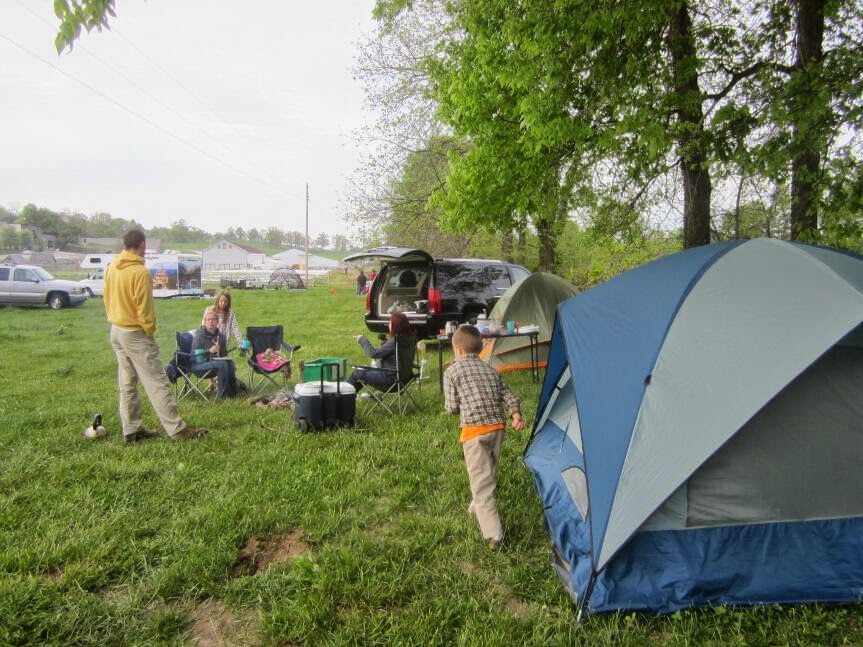
One aspect we thoroughly enjoyed at the festival was free camping on-site. We were very thankful that Baker Creek allowed attendees to set up camp in the cow pasture right across from the festival grounds.  There were even bathrooms with flushing toilets and showers!  Camping introduced us to some amazing people who shared common interests in gardening, essential oils, off-grid living, etc.  Campers were respectful of each other's space and quiet time and shared meals.  Bluegrass music filled the night air when falling asleep.  Overall we had a great time at the festival and will return again.

Planting the garden was our first priority after returning from our trip!  Using cattle panels as a trellis, Jon and Paul planted Asparagus Beans from Baker Creek.  This is our first year growing these beans and the pods grow to about 24 inches long!

This picture was taken from our second story bedroom window.  The little plot on the left is for sweet corn.  We are using row covers again this year to protect our brassicas from the cabbage worms, melons from the cucumber beetles, and eggplants from the flea beetles.  


Teaching Others About Gardening and Preserving Food


This week I helped my friend, Pam, teach a class on growing and preserving food at a local MOPS group.  This is the same place I taught homemade cleaning projects and soap making in 2014.  The group had a lot of great questions for us and there seemed to be a few interested in starting a small backyard garden and preserving food.

Years ago the very thought of speaking in front of a group sent me into panic mode; but now I willingly accept the invitation.  Why the sudden change?  I have learned that when I am passionate about something, the fear of public speaking goes away.  Teaching is probably my calling in life, but not in the traditional sense like a teacher in a classroom.  I get excited showing others the things my family does and the lessons we have learned.  To see someone else become interested in what we are doing is very satisfying.   

In one hour we covered a lot of topics including:

*Benefits of raising your own food
*Getting started
*Types of gardening (i.e. container vs. raised bed vs. tilled area)
*Canning
*Freezing
*Dehydrating
*Fermenting
*Where to purchase large amounts of produce (i.e. farmer's market, stores locally, neighbors, etc.)
*Benefits of joining a CSA (Community Supported Agriculture)
*Recipes


Pam gave everyone a packet of seeds to take home and we had a lot of stuff for them to look at.  We barely had enough time to cover all the topics and answer questions, but a handout was given to them before leaving.    


Homesteading During a Winter Power Outage

This week I finally got around to transferring pictures from the camera and came across the pictures taken during a three day power outage in early March.  It's hard to believe that happened less than a month ago since the grass is almost ready to be mowed and the garden has been tilled and partially planted already!

On March 5th we received about 10 inches of heavy, wet snow in less than 24 hours creating major power outages throughout the tri-state area.  Losing electricity for an extended period of time is not an uncommon occurrence living 3.5 miles down a back road in West Virginia.  Our first summer here, we went seven days without electricity after a wind storm called a derecho obliterated the state. Ironically that derecho storm gave us the wood we used to keep our pipes from freezing in this storm. In general, folks in the country here have adapted to these situations.  Most have generators, 4-wheel drive vehicles, and chainsaws to remove fallen trees across the road.

Jon and I both grew up in WI and MN so snow storms are not foreign to us.  We stock up on food and stay off the roads until the plows go by.  Well, we waited 48 hours until the plows went by (on only one side) and by then there was a thick, compacted sheet of ice from vehicles and 4 wheelers. The road conditions have to be the most annoying aspect about living in the country in the Appalachian mountains.  Earlier in the winter when we only received a few inches of snow, Jon had to leave his car in town and walk in twenty below zero weather the 3.5 miles to our home because the road turned to solid ice and the temperatures were so cold that the salt they scarcely spread did not work. Needless to say, every car was stranded at the bottom of the big hills irregardless of their 4-wheel drive capabilities.

Going without electricity isn't a big deal for my family because we aren't hooked to electronics and we enjoy making meals and heating water over a fire.  In this instance we went 60 hours without electricity and had night time temperatures reach three below zero Fahrenheit.  Thank goodness we have a fireplace, but without the electric blower pushing warm air into the room, the house didn't really warm up.  The warmth mainly stayed in the living room.  By the second day we moved the tropical plants into the room so they wouldn't freeze.  At night Jon and I slept in the living room and added a log to the fire every 30 minutes or so.  To keep the pipes from freezing, we ran a pencil width of water continuously the entire time.  Keeping warm wasn't our main concern because we had plenty of long underwear and blankets; it was keeping the pipes from freezing and bursting that was our main concern.  At a time like this, a person can't help but think of our ancestors and how they didn't have indoor plumbing and electric freezers full of preserved food to worry about.  Their worries were different of course, but that's not to say I would trade small pox for electricity or a flushing toilet, but it definitely gives reason to have a smaller home with fewer bathrooms and a fireplace that radiates heat on all sides.  There is some comfort in simplifying our home and being self-sufficient.

Eating over a fire is something my family really enjoys.  During the power outage we ate like royalty using our blackened camping pot and cast iron hobo pie makers.  A few meals included: vodka penne pasta, chili, taco mac, vegetable barley soup, and grilled cheese and tomato soup.  

We had three warm meals each day and plenty of warm chai.  It was somewhat like winter camping but indoors.  When the power returned, the thermostat read 50 degrees  

Six large pine trees fell on our property during the storm.  Four fell on the maple syrup boiling area and another fell on two young fruit trees, a pie cherry and Q-18 peach. The day after the power was restored, the temperature rose to the high 50's and all of the snow melted within two days.  This was a storm that came and left in less than a week.  Besides the loss of two fruit trees which Jon is sorely upset about, and the few hours it took to remove the fallen trees, we managed to weather the storm in our own simple way.


A Knife Made By a Local Blacksmith


We had the privilege of meeting our blacksmith neighbor, Charlie, two years ago at a festival.  Jon and I were mesmerized watching him hammer away at a red-hot piece of metal while talking to others about the art of blacksmithing.  He had an infectious personality with a knack for educating others and we just had to talk to him.  Some time during our conversation with Charlie we learned that we only live about a mile from each other!  Charlie and his wife Evelyn, are one of those neighbors you are happy to wave to when they drive by, and they never miss a honk of the horn when they see us.  They are pretty awesome people to know, and give more than a generous amount of their time volunteering at the Heritage Farm Museum in Huntington, WV.

When I asked Charlie how he learned the trade of blacksmithing, he said, "I just taught myself along the way.  If you want to learn something, you can find the information in a bunch of places.  Don't be afraid to fail."  Charlie is truly an inspiration with a myriad of knowledge.  Him and his wife built their own home here in West Virginia using their own mill and have a lot of general knowledge about the area and homesteading.  Before leaving West Virginia, I wanted to take something unique with me from the area, so I asked Charlie to make us a functional knife, not just something decorative.  The knife handle is made from myrtlewood, a native evergreen from Oregon that a deceased friend (and coworker) gave to us during our five year stay in Portland, OR.  We have carried this block of wood with us for years, reserving it for something special because it is a unique hardwood from a special friend.  The seven inch hand-forged blade is 51-60 steel.  The sheath was hand-stitched by Charlie as well.  All together, the knife is a blend of OR and WV.
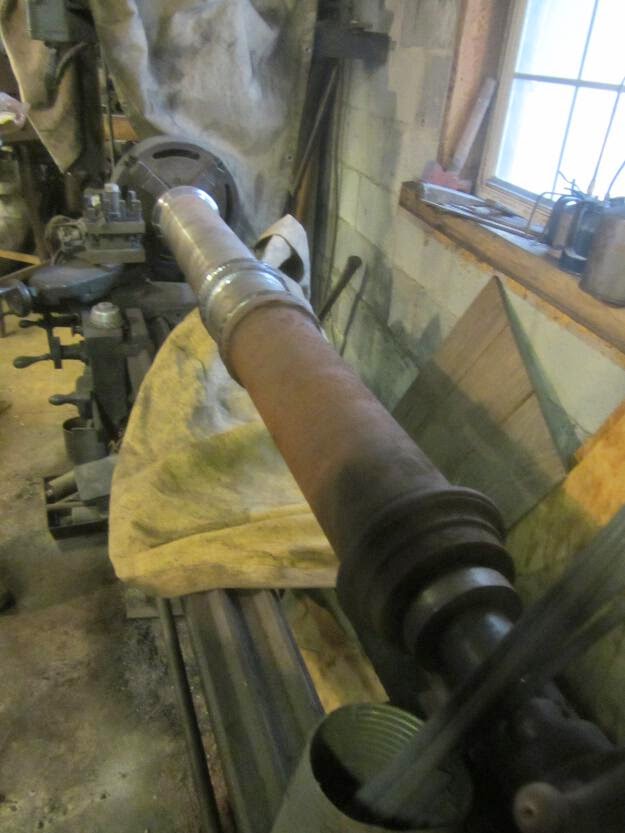
The knife and sheath.

A close-up of the knife handle with his trademark showing on the end of the knife blade.  A large C and B for Charlie Bradley.

A stamp on the blade that reads "C. Bradley Culloden, WV."


It's nice that Charlie stamps the knife with the type of steel used: 51-60.

Knife length.

The leftover chunk of myrtlewood the handle was made from.


The blacksmith shop.

I really like the details Charlie put on the front and side door of his shop.  It's like stepping back in time with the old-fashioned look. 


Inside of the blacksmith shop.

One of many projects he is currently working on, a cannon.

Many tools hanging from the ceiling.


Happy Holidays!


The holiday season is upon us and I want to thank everyone for stopping by my blog throughout the year. It's hard to believe that 2015 is almost here, and I have a feeling that there will be a lot of change for my family.  Looking ahead to the New Year, I am collecting future blog posts and want to ask readers for input on specific topics you would like me to blog about.   Just leave a suggestion in the comment section or send me an email! Happy Holidays to you and your family!

Contributing to a Sustainable Local Market

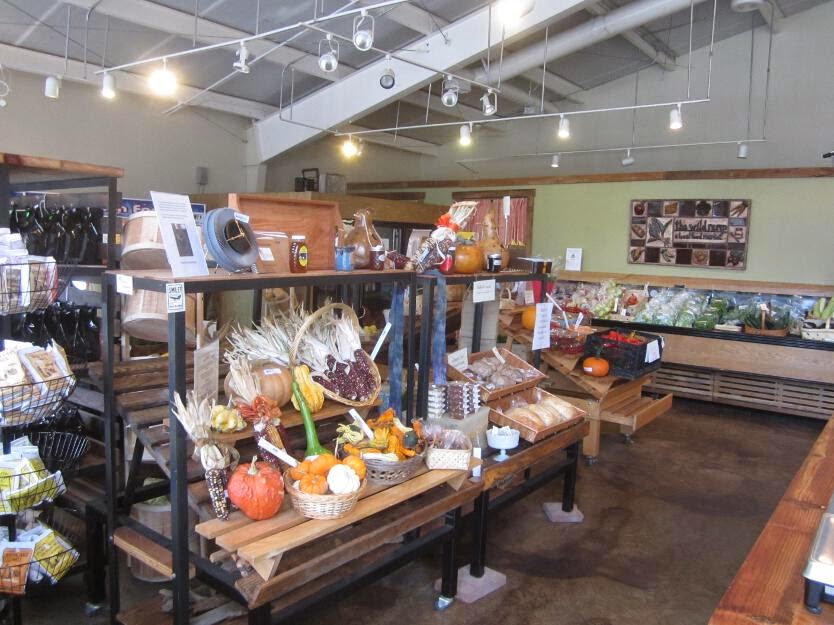
Beginning mid-October this year I started volunteering and selling items at the Wild Ramp, a local food and artisan store selling products grown and made within 250 miles of the store in Huntington, WV.  The Wild Ramp is like an indoor farmer's market where farmers personally drop off their produce and talk with customers; and where handmade artisan products are sold by local community members.  There are only three paid staff members at the Wild Ramp so the store relies heavily on volunteers to keep things going on a weekly basis.  I have been told for several years that Jon and I should sell our handmade toys and wood items that we make.  I always assumed that people wouldn't buy our stuff because of the price we have to charge to make it worth our time.  Well, come to find out, people are willing to pay and it seems that I can't keep up with the demand!  I included a few pictures of items I am currently selling.  Producers pay a $15.00 fee per month to reserve shelf space and receive 90% of the profits.

With the holiday season, I put together a few centerpieces made with holly, pine cones, dried berries, and pine boughs from our woods. 

I have been making holiday wreaths for five years now and they are super easy to make so I made a few to sell.  Like the centerpieces, I gathered supplies in the woods and even tucked a few turkey feathers in the greenery from a friend who raises turkeys.  This was my first year making bows with the help from youtube.

I made a mushroom rattle as a baby gift for a friend four years ago and they were so cute that I made more of them and expanded the rattle design to apple trees and ladybugs.  In less than a month, all of the mushrooms sold!  

On the top shelf in this picture are a bunch of my wooden toys that are really popular at the Wild Ramp.  To see the toys better, click the picture to enlarge.  In one month, I sold all but two of the cars on that shelf and even had a special order for two of the dump trucks.  Like the rattles, I continue to make more and restock the shelf on a weekly basis because they sell out quickly!

Most producers include specific information about their items and where they are located so customers feel more informed about the product.  For instance, meat and dairy products have labels for grass-fed only, grain-finished, free-range, non-GMO feed, etc.  For my toys I tell customers that I use re-purposed wood and seal it with a child-safe linseed and beeswax finish.

These log stools are really cute and modeled after the traditional milking stool.  The logs are gathered from our property.

We are also selling bag drying racks with the message, "Don't throw away your Ziploc bags!  Wash and hang them to dry on this rack."

Overall, volunteering and selling my wares at the Wild Ramp has been a productive use of my time while Paul is in full-day Kindergarten.  Whether it's seeing a customer get excited about my wooden toys or talking about different chicken breeds to the farmer who sells eggs, I have so much fun just being at the Wild Ramp.  It's a place where you feel part of the community and are surrounded by like-minded people. 


Teaching Others About Homemade Cleaning Products

This week I was invited to a local MOPS group to speak about homemade cleaning products.  I was surprised to find so many women eager to learn alternative ways to clean their homes.  We covered everything from floors, bathrooms, laundry to everything in between. 

 In the picture above I am holding a bottle of essential oils talking about the artificial perfumes that are put into products that make us think something is clean.  

The items I brought with me to the class include: vinegar, borax, super washing soda, baking soda, a spray bottle with a vinegar water mix, Fels-Naptha soap, a reusable mop pad, microfiber cloth, rags (instead of paper towels and disposable wipes), essential oils, and gloves.  Before the girls left, they filled their own spray bottle with a vinegar and water mixture (1/2 cup vinegar to 5 cups water) and took home a microfiber cloth.  This is the handout the girls received with recipes to make at home.


About this blog

A weekly update on our adventures of trying to be more self-sufficient by using resources wisely. We explore a variety of topics that most broadly fit in the "Homesteading" category, i.e. beekeeping, organic gardening, edible landscaping/fruit forest, food preservation/canning, woodworking, soap-making, and environmental stewardship.

Search My Blog

I've been featured on:


Followers

Facebook

Contact Form

Name

Email *

Message *

Powered by Blogger.