Simply Resourceful

Simple ways to be more conscious about how we use our resources.

Showing posts with label cattle panel. Show all posts

Growing Asparagus Beans

Every summer we grow something new in the garden.  This year we planted Red-Seeded Asparagus Beans purchased from Baker Creek Heirloom Seeds.  These tasty beans grow really long and are delicious stir-fried.  At one point we couldn't keep up with the supply so we froze them for winter eating.  I blanched them for 1 minute in boiling water followed by a ice bath for 1 minute.


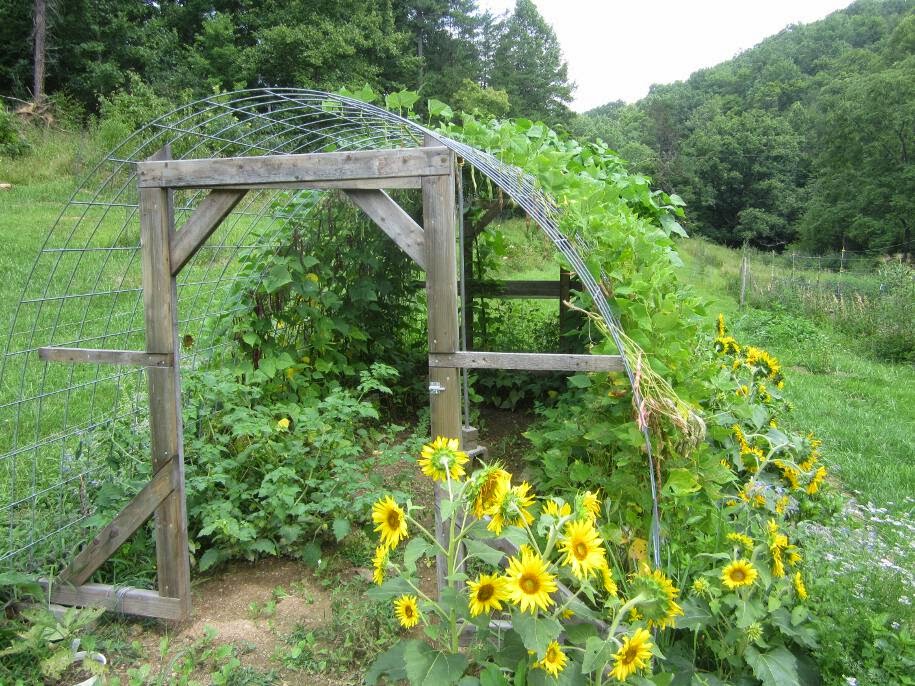
Using a cattle panel for the trellis worked really well and we all enjoyed walking under the jungle of hanging beans.  The beans also made great "dreads" for the garlic pirate!


The pods can grow to 24 inches if you don't pick them fast enough.  They are best eaten when 12-14 inches long.  Picture taken 7-12-2015.

This picture was taken October 3rd and we are still receiving beans!  The beans that are brown and shriveled up will be saved for seed to be used next summer.


Cattle Panel Tomato Trellis Review

As mentioned in a previous post earlier this year, we are using cattle panels as tomato trellises.  I am happy to report they have done a phenomenal job at supporting the tomatoes, providing adequate airflow, and making weeding a quick chore with the weed wacker.  Our rows are seven feet wide which sounds kind of ridiculous, but this distance has really kept the plants from getting tangled together, and we can walk down the rows without brushing leaves and releasing blight spores.  The tomatoes are showing some blight, but it is very minimal this year despite being a wet year. 

This year we also used old t-shirts as tie-backs for the tomato stems.  The t-shirts work well in the tomato patch because they don't cut into the stems like twine and rope do.  


Using Cattle Panels As a Tomato Trellis

Cattle panels seem to be a versatile item around the homestead.  Last year we used them for the greenhouse project and bean trellis.  This year we are using them as a tomato trellis.  I have seen gardeners cut the cattle panels into boxes or lay them parallel to the ground for supporting their tomatoes.  We decided to try a simpler approach of not cutting the panels and just staking them perpendicular to the ground.  The advantage to this approach is easy access to the weeds.  We will see how this method works and give an update later in the summer.

In between the tomatoes we alternated basil and borage.  Basil enhances the tomato flavors while tomatoes enhance basil flavors.  In the picture above you can see a small borage plant to the left of the tomato.  Borage is a companion plant that helps combat the tomato hornworms by attracting the parasitic wasp that lays its eggs on the hornworm.  The wasp larvae kill the worm by eating it.

Look closely...there is a large hornworm on the tomato stem.  If left alone, the hornworm will strip the entire plant of its leaves. 

Here is a dead hornworm after the wasp larvae killed it.


The Best Bean Trellis Ever


This summer we finally have a sturdy bean trellis.  In the past we used the traditional tepee design using logs tied together at the top.  The picture on the left was taken the previous season.  The problem with the tepee is the height and lack of airflow.  When the vines reach the top, they twist on themselves resulting in fewer flowers and beans.  It is a gnarly mess, and by the end of summer, the logs are sprouting mushrooms.  This year after removing the greenhouse plastic, Jon decided to use the frame (which is just cattle panels) as a trellis.  This trellis has produced great results!  There is plenty of airflow and space for the vines to sprawl without twisting on each other. Every day we walk through the greenhouse to gaze up at the hanging beans.  It is pretty to look at!  I included some pictures taken from different angles (click to enlarge).


About this blog

A weekly update on our adventures of trying to be more self-sufficient by using resources wisely. We explore a variety of topics that most broadly fit in the "Homesteading" category, i.e. beekeeping, organic gardening, edible landscaping/fruit forest, food preservation/canning, woodworking, soap-making, and environmental stewardship.

Search My Blog

I've been featured on:


Followers

Facebook

Contact Form

Name

Email *

Message *

Powered by Blogger.